VIB360 Electric Propulsion Monitoring — Detecting an Electromagnetic Stress real time before the Failure
Customer Profile
Customer : Luxury Expedition Cruise Operator from European region
Asset : Main Propulsion Electric Motors (PEM);
Architecture : Twin Shaft System (Port & Starboard)
Motor Type : Squirrel Cage Induction Motor
Motor Specs : 2000 kW / 690V /195RPM
Context
We engaged with the owner of a luxury cruise vessel facing a known issue in one of its electric propulsion drives. While the technical team had identified the affected drive, operational constraints prevented immediate intervention, and they required continuous monitoring to track deterioration. The customer also sought independent technical evidence to support discussions with the OEM. VIB360 electric propulsion module was introduced to monitor the main motor health in real time to clearly differentiate between the healthy and affected motors and also monitor the degradation.
Problem Statement
The owners required a reliable non-invasive solution to continuously monitor the condition of the Port-side propulsion motor, assess the rate of degradation, and clearly differentiate it from the healthy Starboard Side Motor. They also needed objective, independent evidence to support safe operational decisions and substantiate their findings during engagement with the OEM. A one-month trial was initiated to validate the system’s capability in the field.
Vib360 Measurement Setup
The monitoring setup was intentionally minimal and non-intrusive, using only two inputs:
ExistingMotor Encoder Signal – Utilised to capture precise rotational speed and torsional behaviour of the propulsion motor in real time Accelerometer on the Drive-End Bearing – to measure vibration and dynamic response under load
These two inputs were fed into the VIB360 platform, where torsion-based processing and vibration correlation were used to detect electromechanical anomalies, differentiate between the port and starboard units, and track fault progression during the one-month trial.
Physics-Based Diagnostics and Comparison
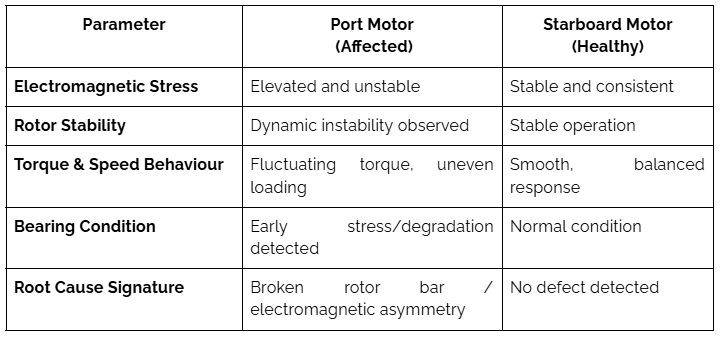
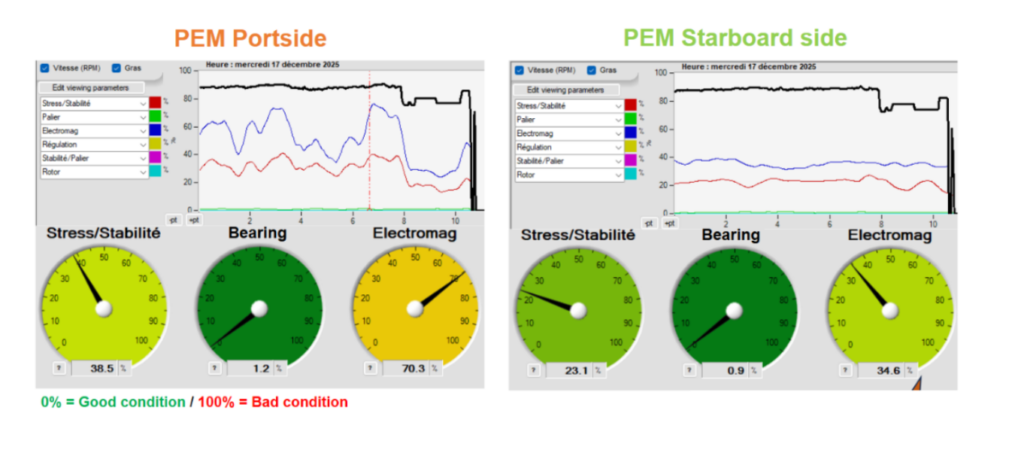
The physics-based analysis clearly differentiated the affected Port motor from the healthy Starboard unit by identifying abnormal electromagnetic behaviour, rotor instability, and associated mechanical stress as tabulated below from day one.
The Starboard motor served as the stable reference condition, confirming that the observed deviations were specific to the Port propulsion system.
Action Taken
A one-month trial was conducted under normal operation, comparing the Port and Starboard motors to track deterioration of the Port motor using physics-based analysis.
Customer replaced the Port Main propulsion Motor and continued the VIB360 monitoring to verify performance result if improve after
VIB360 confirmed the restoration of normal operating behaviour post-replacement
Customer purchased the system following the successful validation
Outcome and Value
Clear differentiation between affected and healthy propulsion units